Brand Crew for Agencies
Give your agency more time for strategy, creative work, and client relationships. Discover how BrandCrew connects client brands, research, campaigns, content, and publishing in one workflow.
- Agency Operations
- Content Strategy
- Marketing Automation
- BrandCrew for Agencies
- Client Management
- Brand Consistency
- Campaign Planning
Your clients need your expertise. Your team needs room to use it.
Agency work rarely slows down because the team has run out of ideas. It slows down when an account manager has to find the latest brief, a writer needs the brand guidelines again, and someone interrupts a strategy session to publish a post. Multiply those small tasks across a growing client list and coordination starts to consume the week.
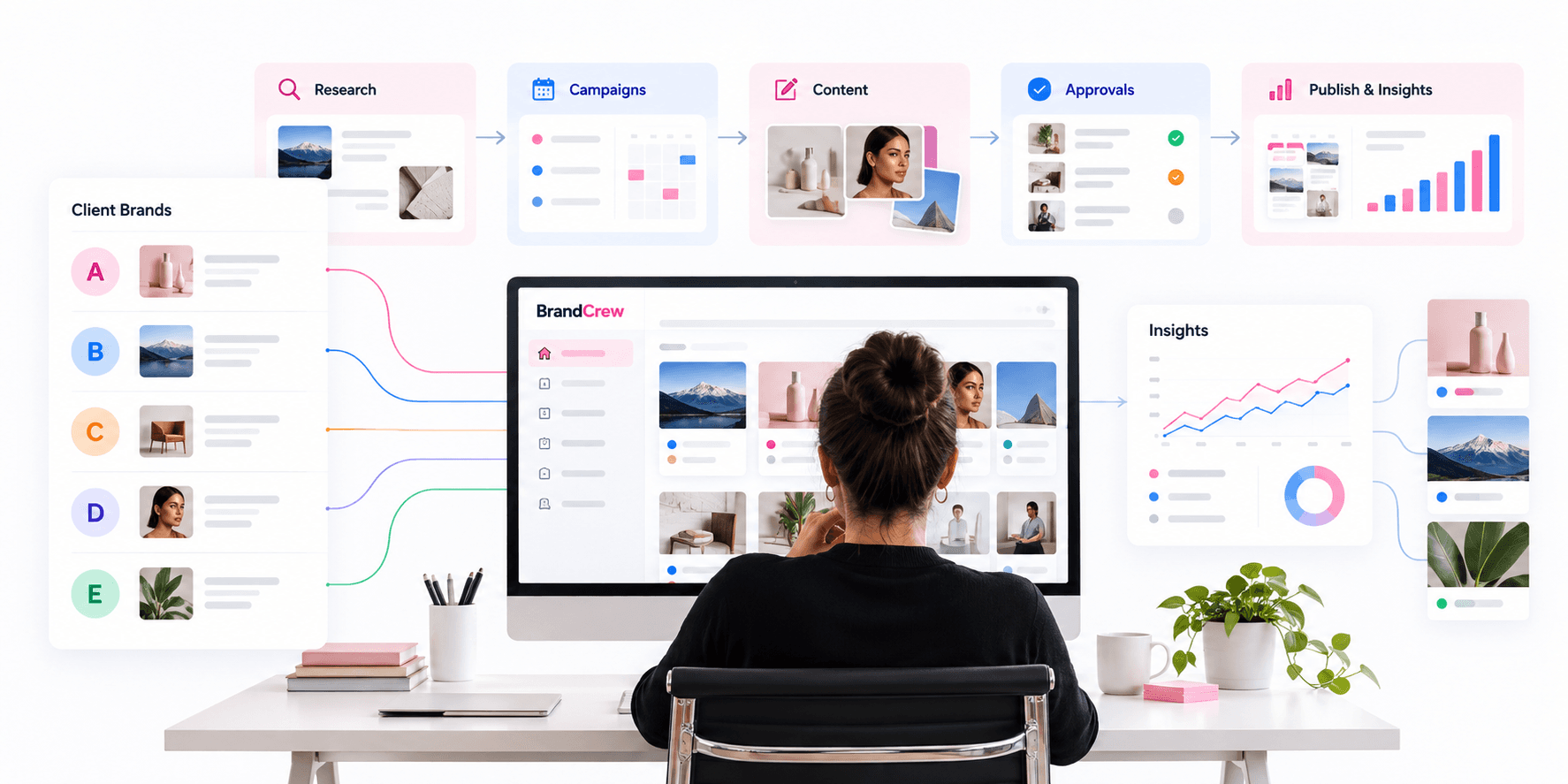
BrandCrew for agencies brings client context, research, campaign planning, content creation, and publishing into a connected workflow. Your agency provides the direction, taste, and judgment. BrandCrew helps with the recurring work that turns that direction into a steady stream of content.
For social media, digital marketing, creative, content, and brand agencies, the practical benefit is continuity: less time rebuilding context at every handoff and more time improving the work your clients actually see.
Keep every client’s work in its own brand workspace
Managing several accounts means remembering several different businesses. A skincare client’s audience, product claims, and tone have little in common with a travel company’s seasonal offers. When those details live across scattered documents and conversations, even a simple draft can involve a long search.
BrandCrew supports multiple brands from one account, with each brand’s documents, campaigns, content, settings, and channel connections scoped to that brand. Open the relevant workspace and continue with that client’s context close to the work. Brand limits and capacity depend on your plan.
Make onboarding the foundation. Gather the client’s website, approved product information, audience notes, and brand guidelines before starting the first campaign. A well-prepared workspace gives your agency a more useful starting point every time the account needs attention.
- Keep client materials with the campaigns they inform.
- Switch brands without rebuilding the brief from memory.
- Connect the appropriate publishing accounts for each client.
Carry the brand voice from one campaign to the next
A first draft is only useful if it sounds like the client. Agencies often spend revision time correcting the same basics: an overly casual tone, the wrong audience, an outdated product description, or language the client would never use.
Saved guidelines and Brand Memory carry approved direction into future content. Add the client’s tone, audience, product details, and preferred language, then refine that guidance as the relationship develops. Your team can focus its editorial attention on the idea and execution instead of repeatedly explaining the brand.
For example, an agency working with a premium homeware brand could record its restrained tone, material details, and preference for practical styling advice. Future campaign drafts then have a consistent foundation. Editors should still check facts, offers, and claims before approval, particularly when a client changes its products or positioning.
Use research to shape the next client conversation
Useful strategy starts before the content calendar. Your team needs to understand what competitors are saying, what audiences are discussing, and which changes in the market deserve a response. Repeating that research manually for every account makes it harder to keep the work current.
BrandCrew brings mentions, market signals, and sourced recommendations into the client’s workspace. Strategists can use those inputs to identify questions worth answering and angles worth developing, then review the underlying sources before making a recommendation.
Suppose several competitors are promoting similar seasonal offers. The opportunity may be to explain a client’s distinctive service, answer a neglected buyer question, or demonstrate a product in use. Research gives your team something concrete to discuss; your agency decides which finding belongs in the campaign.
Turn one campaign brief into coordinated content
A campaign can involve a plan, social captions, email copy, and visuals. When each piece starts in a separate tool with a separate brief, the team spends extra time making the work agree with itself.
BrandCrew lets your agency develop campaign plans and draft content using the same client context. Start with the objective, audience, offer, key message, and intended channels. Use the resulting drafts as material for your creatives to refine for each format.
For a new product launch, that might mean a campaign built around the customer problem, a series of social posts showing use cases, and an email explaining the offer. The message stays connected while the execution changes for the channel. Your team still chooses the strongest ideas, checks the details, and makes the final creative decisions.
- Define the campaign objective before requesting content.
- Give every draft the same approved product and audience context.
- Adapt the message to each channel instead of repeating identical copy.
Keep review and approval in the agency workflow
Producing drafts faster only helps if the agency can maintain its standards. BrandCrew supports reviewing and approving content before publishing, so your team can revise the work, apply client feedback, and decide what is ready.
Build a clear review habit around that capability. Check the brand voice, factual accuracy, offer terms, creative quality, and channel fit. When a client requests a change that should apply to future work, update the saved guidance as well as the individual draft.
Client participation differs between agencies. Discuss your requirements for client access, review links, revision handling, and approval history during an agency session so the available setup matches your process. Keep responsibility for the final decision clear before adding automation.
Schedule delivery and bring useful findings to client reviews
Once content is ready, publishing should not become a series of interruptions throughout the day. BrandCrew can publish or schedule content to supported connected social accounts, while Gmail supports sending and scheduling email campaigns. Available formats depend on the connected platform.
Prepare the schedule around each client’s priorities, confirm the right account and timing, and give your team room to return to strategy and client service. The agency page explains the channel options, including where publishing is subject to platform approval or a connection provides research or analytics rather than publishing.
After delivery, use campaign progress, available channel analytics, and downloadable intelligence reports to prepare client discussions. Bring a short account of what happened, what the available evidence suggests, and what you recommend next. Keep conclusions proportionate to the data: a change in engagement can inform the next creative experiment, but it does not by itself establish a sales result.
Start with one client and a workflow your team can repeat
The most useful first step is a focused client campaign. Choose an account with clear brand materials and a recurring content need. Set up its brand context, bring together the research, create a campaign brief, refine the drafts, and schedule approved content on the supported channels you use.
As your team works, note where it spends time: finding information, correcting brand basics, coordinating drafts, or preparing the client update. Use those observations to decide which parts of the workflow to standardize across other accounts. The benefit will depend on your existing process, campaign complexity, and review requirements.
When discussing an agency plan, bring the number of brands you manage, your expected content volume, and your team and client access requirements. BrandCrew’s agency offering is based on brands and capacity rather than per-seat fees; confirm the features, permissions, and capacity available for your setup.
Conclusion
Your agency’s value comes from understanding clients, choosing a direction, and producing work that earns attention. BrandCrew helps connect the everyday steps around that work, from brand context and research to drafts, review, and scheduling.
Explore BrandCrew for agencies, or book a free agency session with a real client workflow in mind. Bring the task that takes too much of your week and discuss how BrandCrew can help your team handle it.
Frequently asked questions
Can an agency manage multiple clients in BrandCrew?
Yes. BrandCrew supports multiple brands from one account, each with its own context, campaigns, content, settings, and channel connections. The number of brands and available capacity depend on the plan.
Will BrandCrew keep each client’s voice consistent?
Saved guidelines and Brand Memory carry approved brand direction into future content. Give each brand clear audience, tone, and product guidance, and keep an editorial review step before publishing.
Can our team review content before it goes live?
Yes. Your team can review, revise, and approve content before publishing or scheduling. Confirm client access, review-link options, and approval-history requirements during your agency session.
How do we find the right agency plan?
Bring your client count, content needs, supported channels, and access requirements to an agency session. The team can discuss the brand limits, capacity, and available features that fit your workflow.
Recommended reading
Keep reading
- 5 min read
The Synergistic Sprint: Accelerating High-Volume SEO Content With AI-Powered Brand-Agency Workflows
Discover how AI-driven marketing automation platforms like BrandCrew can bridge the gap between brands and agencies, enabling a faster, more efficient, and higher-quality output of SEO-optimized blog content. This post dives into practical strategies for leveraging AI to streamline ideation, creation, and publication in a collaborative environment.
Read article - 6 min read
Beyond The Brief: Cultivating Evergreen SEO Authority With AI-Driven Content Pillars
This post explores how brands and agencies can leverage AI to move beyond ephemeral content trends and build lasting SEO authority by establishing and nurturing evergreen content pillars. It delves into identifying foundational topics, structuring comprehensive content hubs, and maintaining their relevance through AI-powered analysis and updates, all facilitated by platforms like BrandCrew.
Read article - 6 min read
Unlocking Editorial Agility: AI-Powered Content Cadence For Brands And Agencies
In today's fast-paced digital landscape, maintaining a consistent and high-quality blog output is paramount for SEO success. This post explores how Artificial Intelligence, integrated within platforms like BrandCrew, empowers brands and their agency partners to achieve remarkable editorial agility and establish a predictable content cadence that drives organic growth.
Read article