Graza Brand Strategy Analysis: Turning Iconic Packaging Into Repeat Purchase
A BrandCrew Brand Lab analysis of how Graza can turn distinctive packaging, product education, and public customer signals into clearer proof and stronger repeat purchase.
- Brand Strategy
- Brand Lab
- Consumer Marketing
- Campaign Strategy
- Graza
- brand analysis
- consumer brands
- packaging strategy
- customer retention
Why Graza is an excellent brand strategy case study
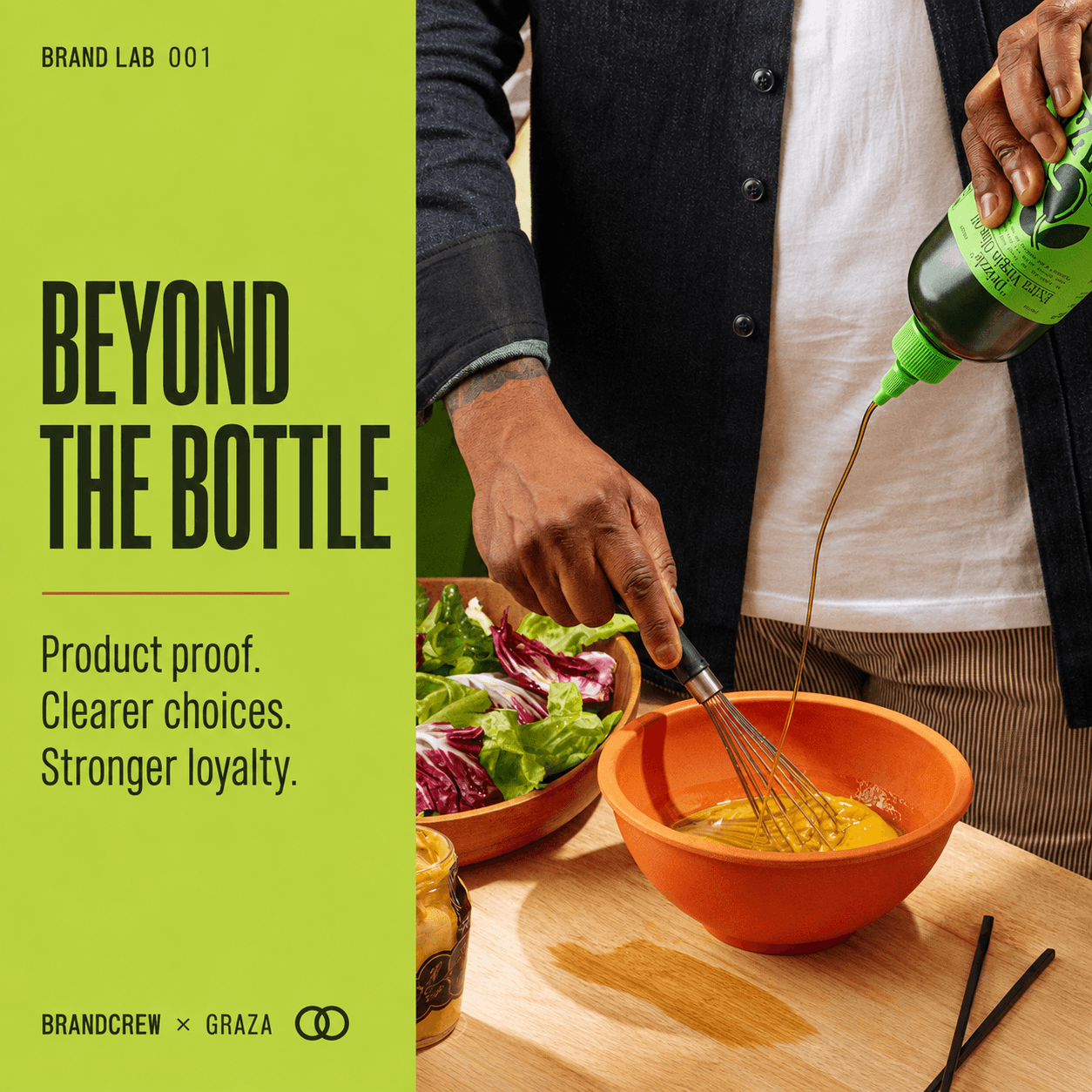
Graza entered a visually conservative olive oil category with a proposition shoppers could understand in seconds. Sizzle is the everyday cooking oil. Drizzle is the finishing oil. The squeeze bottle turns that distinction into a behavior, not just a label. This is strong brand design because the name, package, and use case reinforce one another. Bloomberg has described the packaging as central to the company's breakout, while Graza's own product pages continue to lead with simple cooking roles. The result is unusually high recognition for a young pantry brand. BrandCrew's analysis does not begin by changing that strength. It asks how Graza can make the quality of the oil, the expanding range, and the reasons to repurchase as memorable as the original bottle.
- Keep the Sizzle and Drizzle distinction as the core memory structure.
- Treat the squeeze bottle as a behavior-changing product feature, not decoration.
- Build the next stage of growth around proof and retention rather than reinvention.
The opportunity: make product proof as memorable as the packaging
Graza already communicates useful facts: origin, harvest timing, olive varietals, freshness, flavor, and different jobs for each oil. The opportunity is not to create more claims. It is to organize the strongest evidence into a repeatable proof system that appears wherever a shopper is deciding. A finishing-oil customer may care about peppery flavor and early harvest. An everyday cook may care about versatility, freshness, and value per use. A skeptical category buyer may want clearer sourcing and quality evidence. BrandCrew would map those questions to the claims Graza can substantiate, then turn them into product-page modules, retail content, creator briefs, short videos, comparison posts, and email sequences. Recognition gets attention; specific evidence gives that attention a reason to convert.
- Surface current harvest, origin, varietal, and sensory notes near the buying decision.
- Match proof to the customer's job instead of repeating one message everywhere.
- Use verifiable evidence and customer language rather than broad quality claims.
Simplify a range that is becoming more complex
The original two-product system has expanded. Graza now presents Sizzle, Drizzle, and Frizzle across squeeze bottles, glass bottles, refill cans, and spray formats, alongside adjacent products such as mayo and potato chips. Expansion creates more occasions to buy, but it also creates more decisions. The clearest architecture starts with the cooking job: high heat, everyday cooking, or finishing. Only after that choice should the shopper select a preferred vessel such as squeeze, glass, refill, or spray. That hierarchy can become a compact visual used on the website, retailer pages, packaging, paid social, and creator content. It protects the playful brand voice while reducing the cognitive work required to choose.
- Step 1: choose high heat, everyday cooking, or finishing.
- Step 2: choose squeeze, glass, refill, or spray.
- Step 3: recommend the next product based on the customer's actual use pattern.
Turn packaging questions into a transparent campaign
The squeeze bottle is Graza's most recognizable asset and one of the most repeated topics in public category conversation. Some customers love the control and convenience. Others raise questions about plastic, storage, sustainability, leakage, or whether the packaging overshadows the oil. Graza has already responded by offering recyclable formats, refill cans, and glass bottles. The next move is to make that response a visible campaign rather than information people must find in an FAQ. A format-comparison series could explain which vessel suits which customer, how each protects freshness, how to refill and recycle it, and why the brand offers choice. Transparent education would preserve the squeeze bottle's distinctiveness while showing that Graza listens and adapts.
- Create a clear squeeze-versus-glass-versus-refill comparison.
- Demonstrate storage, freshness, refilling, and recycling in useful short-form content.
- Track whether packaging education changes sentiment, conversion, and repeat purchase.
Design the campaign around the second purchase
A memorable launch can generate trial, but durable growth depends on what happens after the bottle enters the kitchen. BrandCrew would segment campaigns around observed customer behavior: the frequent cook who empties Sizzle, the flavor seeker who uses Drizzle, the refill-minded household, the subscriber, and the customer ready to explore another Graza product. Each segment needs a different next action. Recipes can be triggered by the oil someone bought. Refill reminders can reflect realistic consumption windows. Reviews can be requested after enough time for meaningful use. Bundles can introduce a complementary product instead of offering a generic discount. This turns the brand from a famous object on the counter into a useful cooking system.
- Build post-purchase journeys around products and consumption patterns.
- Use recipes to demonstrate repeatable value, not merely fill a content calendar.
- Measure refill, subscription, cross-sell, and repeat-purchase behavior by campaign.
How BrandCrew would run the Graza growth loop
BrandCrew brings the work into one continuous system. It monitors customer reviews, social discussion, competitor moves, search demand, and campaign performance. It turns those signals into structured brand intelligence, identifies the most useful campaign opportunity, creates channel-specific content, publishes through connected accounts, and learns from the result. For Graza, the first campaign could focus on product proof, format choice, or repeat use. The important difference is that the recommendation is connected to evidence and the published campaign is connected to performance. That closes the gap between brand listening and campaign execution, helping a team move quickly without reducing strategy to generic AI output.
- Listen: collect and classify real market and customer signals.
- Decide: prioritize the opportunity with the strongest evidence and business value.
- Execute: create, publish, measure, and improve the campaign across channels.
Conclusion
Graza does not need a new identity. It needs to extend the clarity of its original idea into proof, product choice, packaging education, and retention. The squeeze bottle can continue to win attention, while a stronger evidence system gives customers more reasons to trust the oil and buy it again. That is the BrandCrew approach: preserve what makes a brand distinctive, listen to what the market is actually saying, and turn those signals into campaigns that improve with every cycle.
Frequently asked questions
What makes Graza's brand strategy distinctive?
Graza connects memorable product names, clear cooking use cases, and distinctive squeeze packaging. Sizzle is positioned for everyday cooking, while Drizzle is positioned for finishing.
What could Graza improve in its marketing?
The strongest opportunities are making product proof more prominent, simplifying its expanded product and packaging range, answering packaging concerns transparently, and building campaigns around repeat purchase.
How would BrandCrew help a consumer brand like Graza?
BrandCrew monitors public signals, organizes them into brand intelligence, recommends evidence-led campaigns, creates channel-specific content, publishes it, and uses performance to improve the next campaign.
Research sources
This independent BrandCrew Brand Lab analysis is based on publicly available information. BrandCrew is not affiliated with or sponsored by Graza.
Recommended reading
Keep reading
- 5 min read
The Synergistic Sprint: Accelerating High-Volume SEO Content With AI-Powered Brand-Agency Workflows
Discover how AI-driven marketing automation platforms like BrandCrew can bridge the gap between brands and agencies, enabling a faster, more efficient, and higher-quality output of SEO-optimized blog content. This post dives into practical strategies for leveraging AI to streamline ideation, creation, and publication in a collaborative environment.
Read article - 6 min read
Beyond The Brief: Cultivating Evergreen SEO Authority With AI-Driven Content Pillars
This post explores how brands and agencies can leverage AI to move beyond ephemeral content trends and build lasting SEO authority by establishing and nurturing evergreen content pillars. It delves into identifying foundational topics, structuring comprehensive content hubs, and maintaining their relevance through AI-powered analysis and updates, all facilitated by platforms like BrandCrew.
Read article - 6 min read
Unlocking Editorial Agility: AI-Powered Content Cadence For Brands And Agencies
In today's fast-paced digital landscape, maintaining a consistent and high-quality blog output is paramount for SEO success. This post explores how Artificial Intelligence, integrated within platforms like BrandCrew, empowers brands and their agency partners to achieve remarkable editorial agility and establish a predictable content cadence that drives organic growth.
Read article